Silver Purity & Hallmarks: 999, 958, 925, 900 and 800 Silver Explained
What Do Silver Hallmarks Mean?
If you look closely at a silver ring, necklace, spoon, coin, or other silver item, you may find a small number stamped into the metal. Marks such as 999, 958, 925, 900, or 800 usually indicate the purity of the silver.
Pure silver is a relatively soft metal, so it is often mixed with other metals to improve its strength and durability. The number stamped on an item tells you approximately how much pure silver is present in the alloy.
How Is Silver Purity Measured?
Silver purity is commonly expressed using millesimal fineness. This system measures the amount of pure silver in 1,000 parts of the alloy.
For example:
- 999 silver contains 999 parts silver per 1,000, or 99.9% pure silver.
- 925 silver contains 925 parts silver per 1,000, or 92.5% pure silver.
- 800 silver contains 800 parts silver per 1,000, or 80% pure silver.
The remaining percentage normally consists of other metals, most commonly copper, although the exact alloy composition can vary.
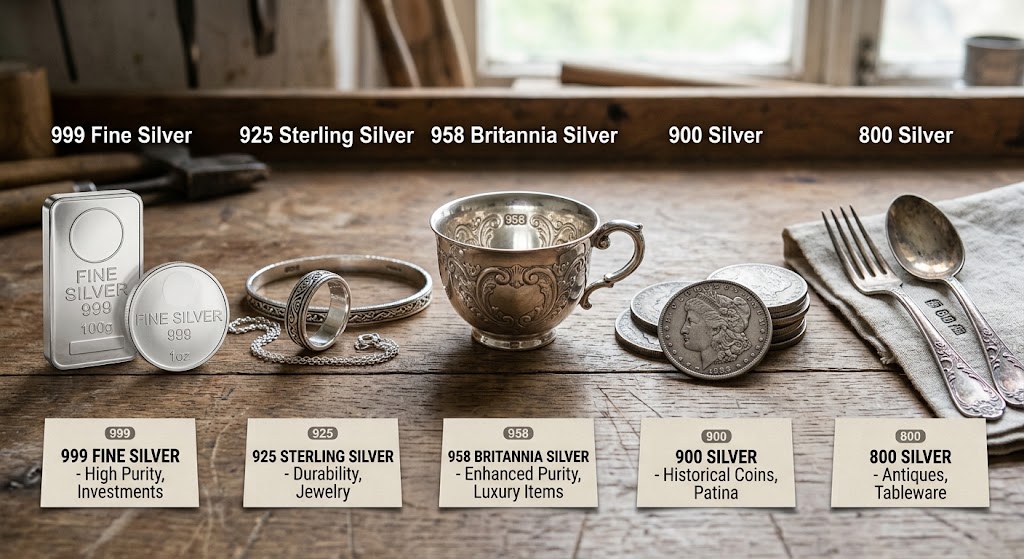
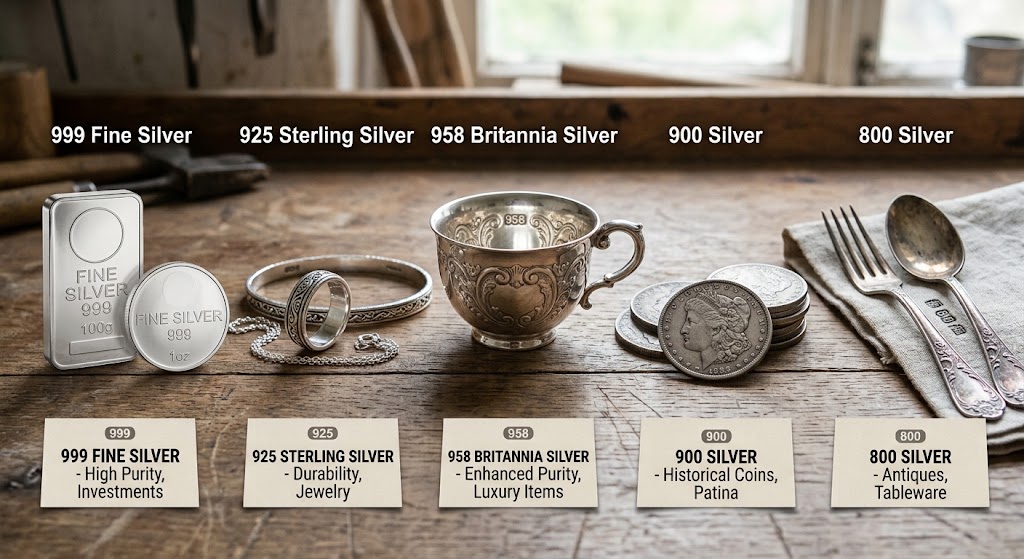
999 Silver — Fine Silver
999 silver, often called fine silver, is approximately 99.9% pure silver. It is one of the highest purity levels commonly found in commercially available silver products.
Because fine silver is relatively soft, it is less suitable for jewelry or objects that must withstand frequent wear. However, its high purity makes it particularly common in investment products such as silver bars and some bullion coins.
Typical markings may include 999, .999, or the words Fine Silver.
958 Silver — Britannia Silver
958 silver contains approximately 95.8% pure silver. This standard is traditionally associated with Britannia silver.
Britannia silver has a higher silver content than sterling silver. Historically, it has been used for silverware and decorative objects, particularly in Britain.
The precise traditional Britannia standard is 958.4 parts of silver per 1,000, although it is commonly described simply as 958 silver.
925 Silver — Sterling Silver
925 silver is one of the most widely recognized silver standards in the world. It contains 92.5% pure silver and 7.5% other metals.
This alloy is commonly known as sterling silver. Copper is frequently used as the main additional metal because it makes the silver harder and more suitable for everyday use while preserving its appearance.
Sterling silver is widely used for:
- rings and earrings;
- necklaces and bracelets;
- silverware;
- decorative objects;
- collectible items.
Common markings include 925, .925, Sterling, and Sterling Silver.
900 Silver — Coin Silver
900 silver contains 90% pure silver and 10% other metals. It is often associated with historical silver coins, which is why the term coin silver is sometimes used when discussing alloys around this purity level.
Many historical circulating coins contained silver, but their purity varied considerably depending on the country and period. Therefore, a coin should not be assumed to contain 90% silver simply because it is described as a "silver coin."
800 Silver
800 silver contains 80% pure silver and 20% other metals. It is less pure than sterling silver but has historically been used for silverware, tableware, jewelry, and decorative objects in various countries.
Items marked 800 are genuine silver alloys, but their silver content is lower than that of 925 sterling silver.
Silver Purity Comparison
| Hallmark | Silver Content | Common Name / Use |
|---|---|---|
| 999 | 99.9% | Fine silver, bullion |
| 958 | 95.8% | Britannia silver |
| 925 | 92.5% | Sterling silver, jewelry |
| 900 | 90% | Coins and historical silver objects |
| 800 | 80% | Silverware, jewelry and decorative objects |
Does a 925 Stamp Guarantee That an Item Is Silver?
Not necessarily. A 925 stamp is an indication that an item is intended to be sterling silver, but a stamp alone cannot guarantee its authenticity.
Counterfeit jewelry can also carry fake purity marks. For valuable items, professional testing may be necessary to confirm the actual silver content. Hallmarking systems also differ between countries, and official hallmarks may contain additional symbols identifying an assay office, manufacturer, or date.
Silver-Plated Items Are Different
A silver-colored object is not necessarily made from solid silver. Silver-plated items typically consist of a base metal covered with a thin layer of silver.
Because only the surface contains silver, the total precious-metal value of a silver-plated object can be much lower than that of a solid 925 or 999 silver item of the same weight.
Marks such as EP, EPNS, or other silver-plating terminology may indicate that an object is plated rather than solid silver.
Why Purity Matters for Silver Value
The value of silver contained in an item depends primarily on its weight, purity, and the current market price of silver.
For example, a 100-gram object made from 925 silver contains approximately:
100 g × 0.925 = 92.5 g of pure silver
By comparison, a 100-gram object made from 800 silver contains approximately 80 grams of pure silver.
This calculation represents the theoretical silver content. The actual market value of jewelry, coins, antiques, or collectible objects can differ because of manufacturing costs, condition, rarity, dealer premiums, and other factors.
Which Silver Purity Is Best?
There is no single silver purity that is best for every purpose.
- 999 silver is particularly suitable when high purity is important, such as for bullion.
- 925 sterling silver offers a useful balance between silver content and durability, making it popular for jewelry.
- 958 silver provides higher purity than sterling while still being used for manufactured silver objects.
- 900 and 800 silver are frequently encountered in historical coins, silverware, and older decorative items.
Frequently Asked Questions
What does 925 mean on silver?
A 925 mark indicates that the alloy contains approximately 92.5% pure silver. This standard is commonly known as sterling silver.
Is 999 silver better than 925 silver?
999 silver has a higher silver content, but that does not automatically make it better for every purpose. Fine silver is softer, while 925 sterling silver is generally more durable and therefore widely used for jewelry.
Is 800 silver real silver?
Yes. An 800 silver alloy contains approximately 80% pure silver. It has a lower silver content than sterling silver but is still a genuine silver alloy.
What is the difference between sterling silver and 925 silver?
In terms of purity, there is normally no difference. Sterling silver is the name of an alloy containing approximately 92.5% silver, which is why it is commonly marked 925.
Can silver have no hallmark?
Yes. Older objects, handmade pieces, items produced in countries with different hallmarking requirements, and very small pieces may have no easily visible purity mark. The absence of a hallmark alone does not prove that an item is not silver.
Published on | Last updated: